
Don't miss the 5 reasons why circumcision and the law are incompatible.

The law around circumcision is less of a “grey area” and more of a murky brown. This month 15 Square were proud participants of the Worldwide Day Of Genital Autonomy.
Our presentation was inspired by the obstacles that prevent justice regarding circumcision.
With regards to circumcision law and medical policies, 15 Square sees it as a 3 tier problem. Where we law and policy should be, where law and policy is, and then how this works in practice.
With Denmark considering an age limit of 18 before true informed consent and irreversible body modification can take place by means of circumcision, Intact Denmark is able to steer the conversation towards “ideal legislation”.
With the obstacles that the rest of the world face, 15 Square advocates closing the gap between current legislation and what actually happens in practice.
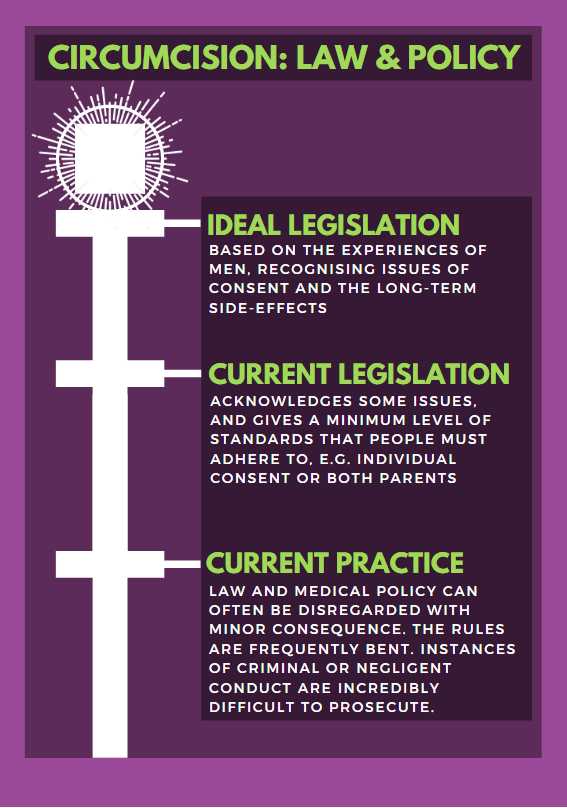
In many countries such as the UK, in order to put forward a case for prosecution the Crown Prosecution Service must follow a code. The CPS must deem that the case will have “a realistic prospect of conviction” based on the evidence provided. There have been cases in the UK involving circumcision where there is blatant breaking of the rule of law, but without any enforcement of law and proportionate consequence.
The Nottingham Case
Three Arrested Over Boy’s Circumcision -> ‘No Consent’ Circumcision Doctor Suspended For a Month
The Medical Practitioners Tribunal Service found his actions were a “serious breach” of GMC guidance, and his fitness to practise was impaired by reason of misconduct.
However, it decided there was a “very low risk of repetition” and “no risk to patients” by allowing him to continue working.
The Bad Pharmacist Case
Pharmacist Convicted of Having Boy Circumcised Against Parents’ Wishes
Judge Freya Newbery conceded Obi-Uzom had committed a “massive violation,” but insisted she contributed to her community, including charity work with disadvantaged children. She added there was a “vanishingly small risk of re-offending.”
…Prosecutor Louis Mably insisted that the unauthorized circumcision resulted in “irreversible and lifelong injury” in the boy. “What is unusual is that the harm caused can be caused lawfully, when it is with consent,” he added.
Judge Freya Newbery sentenced Obi-Uzom to 14 months in prison, suspended for 18 months, and ordered her to pay £1,500 in prosecution costs and an additional £140 fee. In addition to her sentence, Obi-Uzom may face professional disciplinary proceedings.
This sends a clear message. There is no significant consequence for breaking the law when it comes to circumcising infants. To change this, it must be clear that there is public interest in challenging circumcision and raising awareness of the harms.
In our presentation 15 Square named 5 different issues that we feel are impeding progress around this social issue.
1. Misrecording non-therapeutic (ritual/cultural) circumcision as ‘medically necessary’. This gives doctors a plausible professional indemnity in the event of complication in later life.
2. Pathologising a healthy and normal foreskin. Code N47 includes several foreskin issues including the false erroneous condition of “redundant prepuce”. This is simply a foreskin which is above average length, and is no more a medical issue than large earlobes, however hospital records often record phimosis, paraphimosis and redundant prepuce together.
3. Costs of a case, the statute of limitations and the lack of medical evidence that is kept on record makes some avenues for prosecution difficult. In the UK, medical records can be discarded after 10 years. This is categorically poor practice for circumcisions as the information is important in some cases of later life complications, or dysfunctions that are only known to the individual who has received the circumcision.
4. The Public interest stage. In all legal proceedings, after asserting that there is enough evidence for a case, they CPS must decide whether they believe it is in the public interest or not. Often, the false assumption that the practice is harmless means that there is a bias towards believing that enforcing the law will be perceived negatively by diaspora’s that practice circumcision. We would argue that this harms many within these communities as lax standards allow inappropriate practice to go largely unchallenged.
5. The lack of record keeping on who was circumcised, why, when, who performed the surgery and a later life followup on physical and psychological affects that are massively under-reported, meaning that it is almost impossible to do academic research into the prevalence of harm.



Be the first to comment